
Most "best food safety app" articles are written by people who have never stood in a kitchen waiting for an inspector to walk through the door. They line up feature lists, quote the cheapest plan each vendor advertises, and call it a comparison. I've spent twenty years in UK food — from independent bakeries through BRC-audited wholesale production — and I can tell you the two things those lists almost always get wrong.
The first is the criteria. A list that ranks apps on "mobile-first" and "one-tap export" but doesn't weight allergen management is measuring the wrong thing, because Natasha's Law isn't optional and it's one of the first things an EHO probes. The second is the price. Nearly every app on the market advertises a low "from" figure that turns out to be an entry tier with the compliance features stripped out. The plan that actually makes you inspection-ready usually costs considerably more — and the honest thing to do is quote that number.
So this guide does both. It sets the criteria the way an inspector thinks, it groups the apps by the shape of business they're built for, and — where I can — it prices each one at the tier where real compliance lives, not the floor.
What actually matters
Five things decide whether a food safety app will hold up when the EHO is standing in your kitchen:
- SFBB / HACCP alignment. Built around the framework you're actually assessed against, not a global product with a UK skin bolted on.
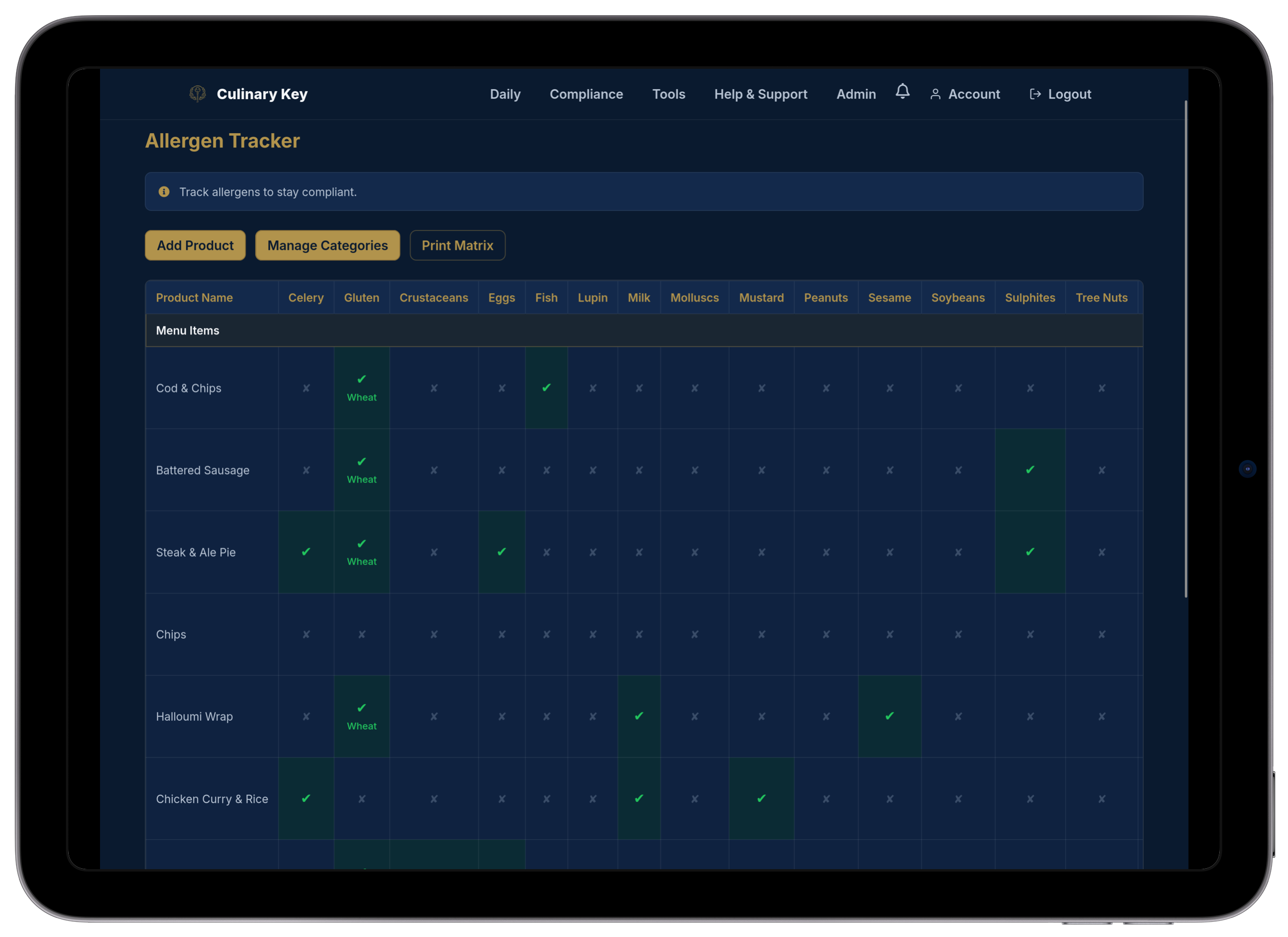
- Allergen management, on every plan. All 14 UK-mandated allergens. If it's missing — or locked behind a higher tier — the app isn't a complete compliance tool, whatever else it does well.
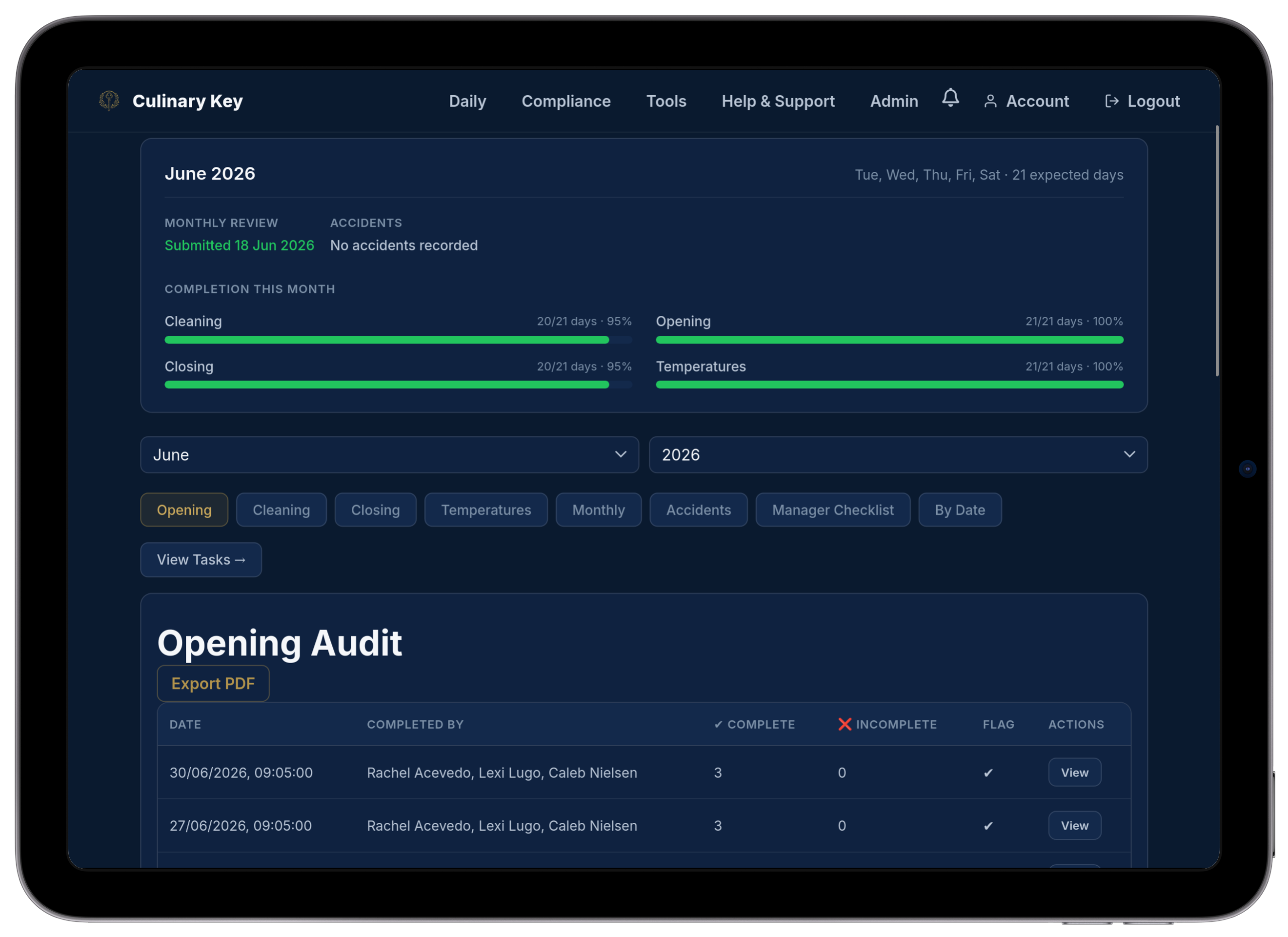
- Inspection-ready record depth. Daily checks and temperatures are the floor. Deliveries, pest control, safe methods, FHRS history and monthly compliance reviews are what an EHO actually asks to see.
- Honest, all-in pricing. One price for the working product — not a floor price that quietly excludes the features you came for.
- Mobile-first execution. The diary has to be where the chef is, logged in seconds, with named entries and real timestamps.
The floor price is not the price
Before the individual apps, the single most useful table in this guide. Every app advertises a headline figure. Here's what it costs to reach the plan that actually makes you compliant — with allergens, HACCP and the records an inspector expects.
| App | Advertised "from" price | Where full compliance actually lives |
|---|---|---|
| SFBB+ | ~£4.99 / mo | No upgrade path — it's a digital diary, not a full system |
| Lemon | £19 / mo (flat) | No allergen or full-compliance tier exists, at any price |
| Hubl | £19 / mo | Allergens £32 · risk assessments £45 · full FSMS on a 12-month contract |
| FoodDocs | ~£17 / site | Reporting, audits and support gated to higher tiers (~£59+) |
| Leafe | £28 / venue | Leafe Pro (~£119 / mo) for HACCP docs, training and investigations |
| Trail | £38 / site (Team, capped at 3 sites) | Standard £65 / site on a 12-month contract |
| Culinary Key | £40 / location | £40 is the full-compliance price — every feature, no tiers |
Read that last column, not the first. For almost every app, the compliance tier sits well above the advertised floor — or doesn't exist at all. There are only two genuine exceptions on flat, all-in pricing: Lemon at £19 and Culinary Key at £40. And the difference between those two is simply what's inside — Lemon is a diary, Culinary Key is the full compliance surface. (Full disclosure: Culinary Key is the app I build. I've marked it clearly throughout, and I've tried to be as hard on it as on anything else.)
Pricing accurate as of July 2026, from each vendor's public site. Always confirm current terms before signing up.
Now the categories.
Category 1 — The budget diary replica
SFBB+ (around £4.99 / month per premises). The cheapest thing on the market, and close to a one-to-one digital copy of the FSA's Safer Food, Better Business pack — same layout, same questions, on a phone. EHOs read it at a glance because it looks like the pages they already know. What it doesn't do: deliveries, allergen management, supplier registers, custom checklists. A single-site operation with basic needs will get honest value. Anything more complex outgrows it inside a year. Best for: a very small, low-risk site that just wants the paper diary on a screen.
Category 2 — Mid-tier apps for independents
The most crowded and competitive part of the market — phone-first apps for single-site to small multi-site operators. This is where most cafés, restaurants, bakeries and takeaways will actually shop, and where the "floor price" problem bites hardest.
Lemon (£19 / month per location, flat). A genuinely good, genuinely simple digital diary — fridge, freezer and hot-hold temperatures, cook / cool / reheat logs, opening, closing and cleaning checklists, deliveries, tracked issues and one-tap exports. Native iOS and Android, unlimited team members, no contract, and around 900 kitchens using it. The price is honest and flat, with no tier games — real credit for that. The catch is scope: no allergen management, no safe methods, no pest control, no FHRS history, no monthly reviews. It's the best diary in this list, and it stops where the diary stops. Best for: a single-site kitchen that needs temperatures and checklists done fast, handles allergens comfortably outside an app, and wants the lowest honest price.
Hubl (from £19 / month, tiered). Made by Complete Food Safety, a Hertfordshire consultancy, with the consultancy relationship as part of the pitch. Well-built, but the entry price is misleading: allergens sit on the second tier (£32), risk assessments on the third (£45), and a full Food Safety Management System on the fourth, on a 12-month contract. Pricing is on enquiry, so you have to talk to them. Best for: an operator who genuinely wants software and consultancy bundled together, and has the budget for the upper tiers.
Leafe (from £28 / venue; Leafe Pro ~£119 / month). Chef-built, mobile-first, EHO-praised, and the broadest product in this category — it extends well past compliance into inventory, rota scheduling, menu management and payroll exporting. It does have allergen management (an allergen matrix), which puts it ahead of Lemon on compliance. But the compliance depth — HACCP documents, training certificates, complaint investigation — lives in Leafe Pro at around £119, and much of what you're paying for is kitchen-ops breadth. Best for: a chef-led business that wants one app for food safety and shifts and menus and stock, and will use all of it. For a business that needs compliance specifically, it's a lot of product you won't touch at a price that reflects features you don't need.
food-safety.app (demo-gated pricing). UK-focused, covering SFBB-style logs, temperature monitoring, deliveries and exports, with claims around AI-assisted HACCP planning. Same gated-pricing friction as Hubl — hard to evaluate without a trial. Best for: worth a look if the AI-HACCP angle appeals and you don't mind a sales conversation first.
Pilla (freemium; paid tiers above). A broader "deskless workforce" platform with food safety as one workflow among several — training, scheduling, document storage. Better for operators who want one app across several adjacent jobs than for those who want a focused food-safety tool. Best for: a small team that wants light food safety alongside staff admin, not a dedicated compliance system.
Culinary Key (£40 / location; £35 from five, £30 from ten — flat, all-in). This is my app, so weigh what follows accordingly. It sits in this category by audience — independents and small multi-site operators — but it's built as a compliance system rather than a diary. It covers the same daily checks as everything above, then carries what the diaries don't: allergen management across all 14 allergens, HACCP safe methods, pest control, FHRS inspection history, monthly SFBB reviews, staff training records, and a read-only Inspector Portal that lets an EHO or Primary Authority officer view your records directly. Every feature is on every plan; there are no tiers and no contract. It's more expensive than Lemon and cheaper than Leafe Pro or Trail Standard — and unlike either, the price you see is the price of the complete product. Currently a mobile web app plus Android, where Lemon has the edge on native polish. Best for: an operator who needs to be genuinely inspection-ready across the full compliance surface, not just diary-ready, and wants it all in one place at one honest price.
Category 3 — Web-based multi-site operations platforms
Trail (Team £38 / site; Standard £65 / site on a 12-month contract). Part of The Access Group, with a customer base that now includes Wagamama, Costa, Gail's and TGI Fridays. Trail's strength isn't food safety in isolation — it's folding compliance into a broad operations layer alongside brand-standard audits, cashing up, rotas, payroll and EPOS integrations. Worth knowing: it's a browser-based web app, not native, and the entry Team plan caps at three sites and excludes dashboards and alerts. Best for: multi-site groups — 20-plus sites — already in the Access ecosystem, where compliance is one part of a bigger operational picture. Overkill for a single independent.
Category 4 — Hardware-led IoT
Navitas Safety (from around £39 / month plus hardware, 12–24 month contracts). Sensors in each unit replace the manual fridge check, with the app aggregating and flagging the data. The pitch is less work and continuous monitoring; the counter-argument is that the manual check is what an EHO actually wants to see, because it represents a moment of human attention to the unit — and the hardware cost and contract lock-in rarely make sense for a small kitchen. Best for: larger or higher-risk operations where continuous cold-chain monitoring genuinely earns its keep.
Category 5 — Enterprise consultancy bundles
Alert65 (by Food Alert, around £20,000 / year). Not really an app so much as software wrapped in a consultancy relationship — advice line, audits, signage, training, policy templates. The buyers are large multi-site groups with a head of compliance, where one bad inspection is enormously costly. Comparing this to a sub-£500-a-year app isn't a meaningful comparison; it's a different product category. Best for: enterprise groups that want compliance run as a managed service.
Category 6 — Global SaaS
FoodDocs (from around £17 / site, rising to ~£59+ on higher tiers). An Estonian global platform with strong third-party reviews and fast, AI-generated HACCP plans as the headline. Highly configurable across regions — a feature if you operate internationally, a trade-off if you're a single UK café paying for flexibility you don't need, with reporting, audits and support gated to the upper tiers. Best for: multi-region operators who value configurability and the AI-HACCP head start over UK-specific depth.
Conclusion
The right answer isn't the app with the longest feature list or the lowest advertised price — it's the one that matches the shape of your compliance obligations, priced at the tier that actually meets them.
If your world genuinely ends at temperatures and checklists on a single site, a good diary like Lemon at £19 is a sensible, honest choice, and I'd say so. If you want food safety folded into full kitchen operations, Leafe has real breadth. If you're an enterprise group, Trail or Alert65 are built for that scale. And if you're an independent or small multi-site operator who has to be inspection-ready across allergens, safe methods, pest control, FHRS history and monthly reviews — and would rather pay one honest price than climb a tier ladder to get there — that's the gap Culinary Key was built to fill.
Whatever you choose: look at the last column of that pricing table, not the first. The floor price is not the price.